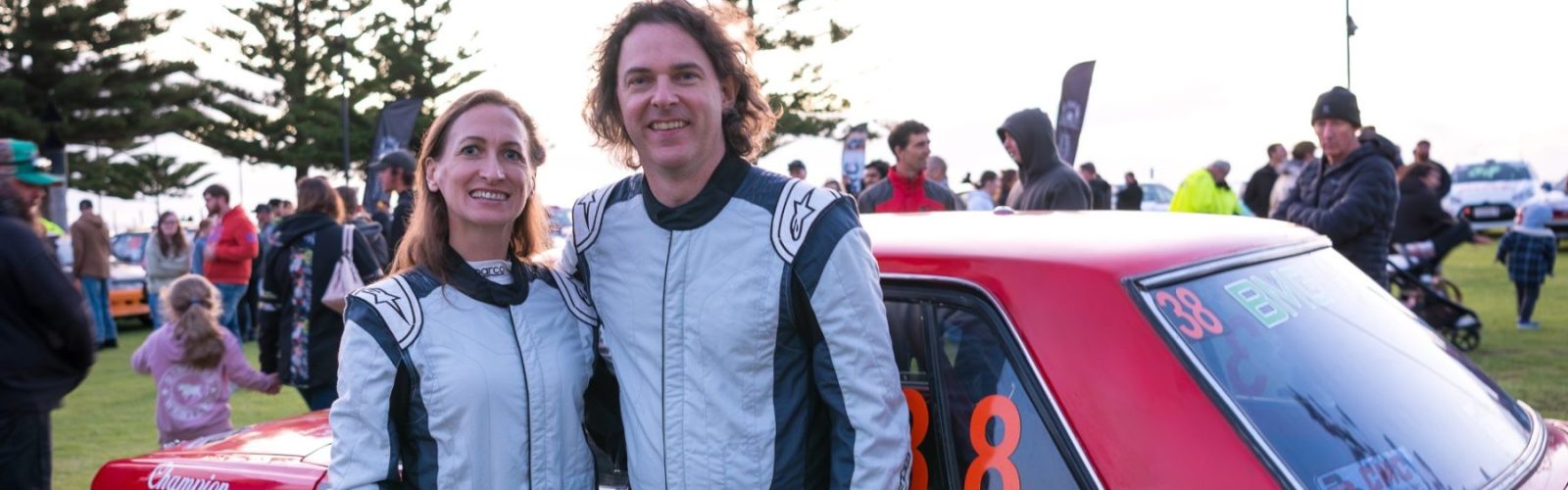
They’ve rallied a Toyota in Thailand, a BMW in the Arctic and a Fiesta in Uruguay.
They’ve taken on WRC candidate events, flown across the world to rally without a proper plan, been their own service crew, got engaged after Rally Barbados and got married in Rovaniemi before testing for the Arctic Rally two days later.
All just because they can.
By its very nature, rallying is a nomadic sport. Forget the titles, the results or the stage times – very few people truly embody what rallying really is like Matt and Catherine Shinnors do.
They’re firmly among the most interesting people I’ve ever had the privilege of interviewing in rallying.
Matt was raised in a motorsport family in Ireland before he graduated as an engineer, but was never destined for a straight-laced life. Taking a sabbatical, he travelled to New Zealand and worked for a race and rally team, which eventually led to him taking on WRC Rally New Zealand in 2006.
Before that, all his rallying had been at home in a Mk2 Escort. Adventure suited him, he just needed someone to share it with.
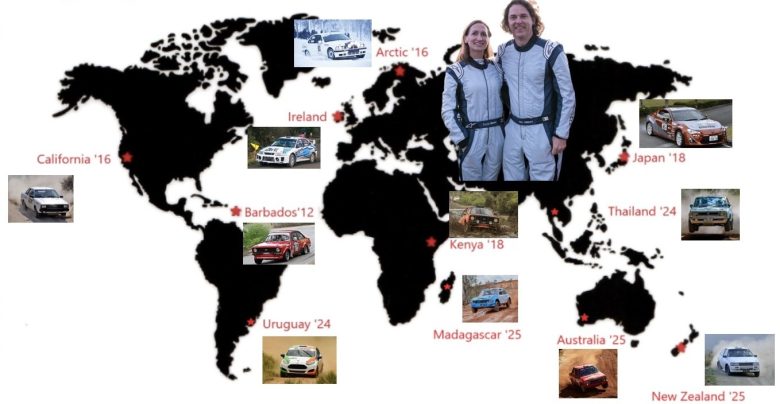
A look at how far the Irish pair have travelled to rally
Catherine’s family wasn’t into rallying. But one of her sister’s friends was heavily involved in the local motor club, and so they went to a local rally school. Inspired by doing things differently to the rest, Catherine learned about Silverstone Rally School’s ‘Lady Quest’ competition where she excelled, but didn’t win for political reasons.
That lit a fire beneath her belly where she simply thought: “I’m going to do this myself. I’ll show them!” She self-taught herself to drive a road car and a rally car, and roped her sister Laurna in to navigate.
Little did he know it, but four-time British Rally champion Keith Cronin actually played cupid. While he was out fighting, and claiming, his first title at Trackrod Rally Yorkshire in 2009, Matt and Catherine met each other on the stages out supporting their mutual friends. Cronin was co-driven by Matt’s cousin, Greg Shinnors, while Cronin is from the same area of Ireland as Catherine.
Individually, they craved the unexpected. Together, they’ve made it their trademark. Talking to them is a lesson in appreciating that life really is for living.
Catherine laughs, remembering the wedding speech, the moment they were labelled a double act. Catherine, who now co-drives for Matt anywhere in the globe they can get to.
“I think we have this philosophy that too much sanity is actually insanity, you know. Life is for living, and we know too many people who’ve stuck very strictly to ‘we must work hard now and save our money for retirement’, and then have been really sick in retirement. And they think, ‘I should have done these things when my body was physically able to do it’.”
Matt interjects: “You know when you come up with a mad idea and you want someone to say, ‘no, no, you can’t do that, that’s stupid?’ With Catherine, I’ll ask ‘how about we do a rally in Kenya, a Safari rally? How about we do that?’ And she’s like ‘tell me more!'”
“It’s always been the mantra of ‘sure, why not?'” Catherine says. “We’re not going out to try and win a rally. We’re going for the experience.
“That puts us in the real thick of it. We’re down with the hammer and tongs kind of competitors; more of the lifeblood of rallying as opposed to the arrive and drive guys who sail in, drink their tea and drive back out. We’re in the ‘eat your sandwich with your dirty hands while changing your tires’ kind of category, you know. Surrounded by fellow enthusiasts.”
“We go for the s***s and giggles,” Matt, ironically, giggles.
Trying to tell every single tale of Matt and Catherine’s global adventures would be impossible. They’ve experienced so much to simply summarize it on a webpage is almost impossible. But that’s exactly the point.
It’s all about talking to people and seeing what might be possible. Even when they’re on vacation, they’ll investigate the rally scene and see what’s available to rent. Usually that’s an old, unfancied car of some description, but their finishing record remains strong.
“It’s not that we mean to drive old cars, it’s just what happens,” Catherine says. “It’s an organic story.
“We were chatting to Eamonn Kelly at the start of an event in Ireland, about the places he’d competed and the people he’d crossed paths with through Junior WRC.
“He then goes, ‘oh, you drive the weirdest stuff, don’t you?”. But for us, it’s part of the adventure – not only what country we end up in, but what kind of a jalopy we drive!”
Is there a favorite memory within all the madness?
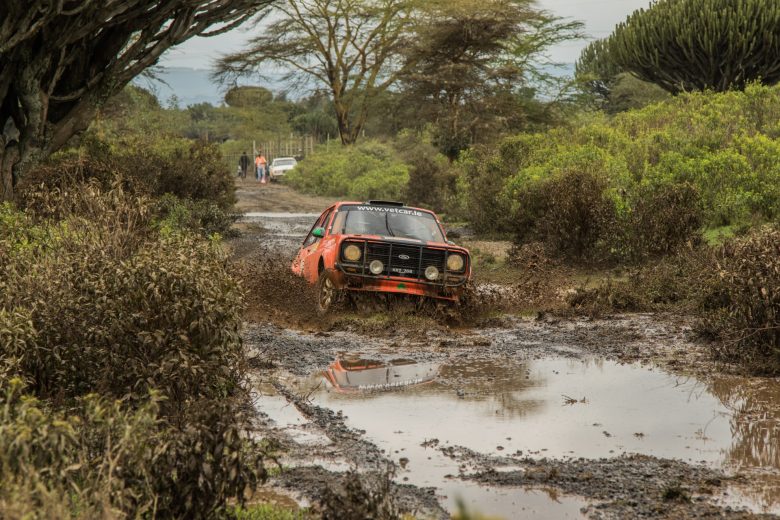
Taking on the Safari Rally in a Mk2 Escort - why not?
“It’s quite difficult, they’re all so different,” Matt admits. “But I think Arctic Rally is such a difficult rally because you’re really out of your comfort zone. Snow and ice, dark, trying to make your notes while it’s bright, the length of the stages (32miles), trying to stay on the road. If you go off, you could die, actually. You have to bring survival stuff like snowmobile suit and timber for a fire with you to keep warm because it’s so cold if you get stuck on a stages. That’s quite challenging, to drive hard there.
“But Barbados, mad. The parties, mad. Very slippy, great craic. Uruguay and New Zealand the gravel roads are just awesome, Australia – slippy ball bearing gravel , California – sandy roads, Thailand – the heat, Safari – the wild animals on the stages, Madagascar – the mud, more madness. It’s… I don’t know, like you can’t compare Japan to Kenya to the Arctic. They’re all so culturally different.”
That constant culture shift does present Catherine with an added challenge, though: the language barrier.
“I have the easy bit,” Matt says, “because I’ve just got to drive the car, she’s got to deal with all that. So fair doos to her trying to figure out the different rules and regulations in each different country and all that kind of stuff.”
“In Thailand, we were trying to use Google Translate to translate the road book,” Catherine smiles. “But at least in Uruguay, it was Spanish, so it was the same alphabet. But in Thailand, when trying to match the roadbook to the road signs, looking at the squiggles, I was like, ‘OK, is that this word?’
“Japan had a little bit of English sometimes because it was the [WRC] candidate event. There was a famous female Japanese navigator, and she prepared a little sheet for me and soin English she’d write like ‘push push’ and things like this that I might need when talking to Japanese people if we got stuck on the stage. So I could just point at the Japanese and at the translations.
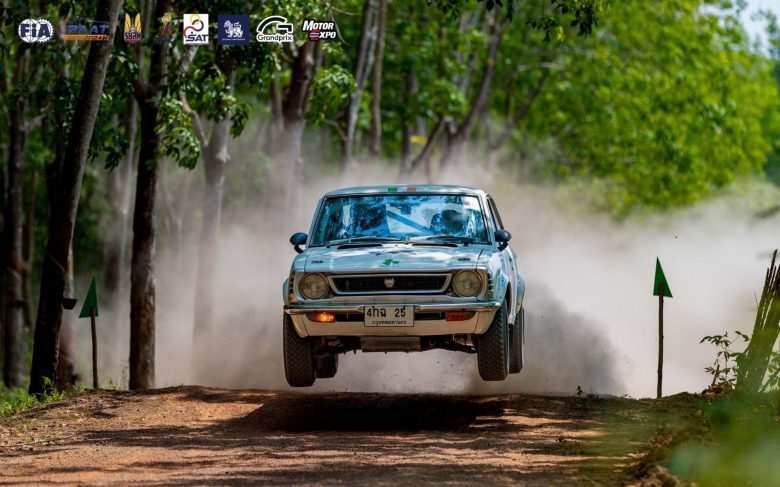
No country, experience or event can truly be compared given how different they all are
“But a lot of the time it’s me trying to use Google Translate. And in Thailand, I remember getting a sheet of paper in the window with alternative roadbook that you haven’t yet translated. And a page of writing you haven’t translated, and we’re due out. And we’re like, ‘OK, we’ll just have to wing it!'”
‘Winging it’ perfectly sums up the pair of them, but in the best possible way. They never know where life, and rallying, is going to take them next. Invariably, that means they make friends in the most bizarre circumstances and in all pockets of the world.
Take when they slid off the road on a perilous road section at the Arctic Rally, for example.
“I’m trying to flag people down and I’m getting out the shovels and I’m digging behind the car. Our car was below the level of the road, waistdeep in snow. Oh my God, it was horrific,” Catherine remembers. “All the rally cars were afraid to stop because they’d lose time, they’d be late for the stage. And we’re like, ‘oh, we’re going to be so late’.
“But the Lithuanians, their service crew were maybe doing chase or something, I don’t know, but they were behind their rally car. And their rally car tried pulling us out and their crew and took over. And they just kept at it, I don’t know how they didn’t wreck their car with the force needed to pull us out.”
Matt comes in: “I’ve never seen guys recovering a car like that. “They built up serious speed before the rope came tight, and with one big tug the car popped out”.
“They nearly wrecked their own personal car!” Catherine says. “It was that diehard spirit of keeping us in the rally. It then turned out their lodgings were just behind ours.
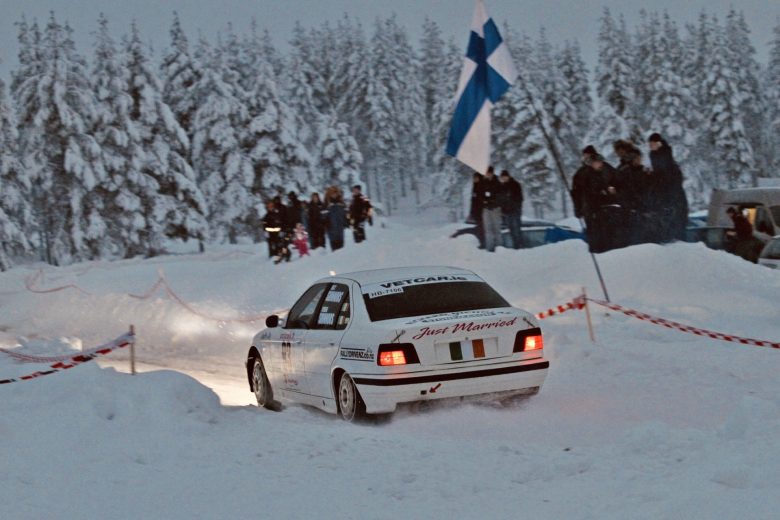
Arctic Rally in 2016 was a memorable experience
“So we’d go over and have a box of beer with them,” Matt grins. “And actually, ” when we went to Rally Estonia, we did a road trip of the Balkans where we started in Lithuania to meet up with these guys. We met them, and they took us around like locals.
For many, life is about the destination and not always the journey. The same applies to rallying. Matt and Catherine are the antithesis to this. Theirs is a story that proves rallying really is for everyone, and can mean absolutely anything you want it to.
“It’s a universal language, motorsport,” Catherine says, shifting to make a serious point. “Because before we started doing these adventures driving, competing abroad, Matt had a motorbike and we used to travel abroad. We followed the Dakar in South America.
“Same thing, you’re out there, we happen to be next to Spanish-speaking people in Argentina, and it’s a universal language. Everyone’s reacting to the race saying, ‘whoa, yay’, whatever. We’re saying something in English to them that they don’t understand, they’re saying something back in Spanish that we don’t understand, and we’re all excited.
“And then you’re eating their barbecued goat under the tree two hours later, you know. It is a unifying thing, motorsport. And especially so at the grassroots level.
“It’s terrible to have regrets, all we are left with is our memories in the nursing home. It’s funny how one person can say something that lifts you up in life, opens a door, and gives you a shove in the right direction. Those are your people. Follow the doers. Listen to the ones out there making things happen.”